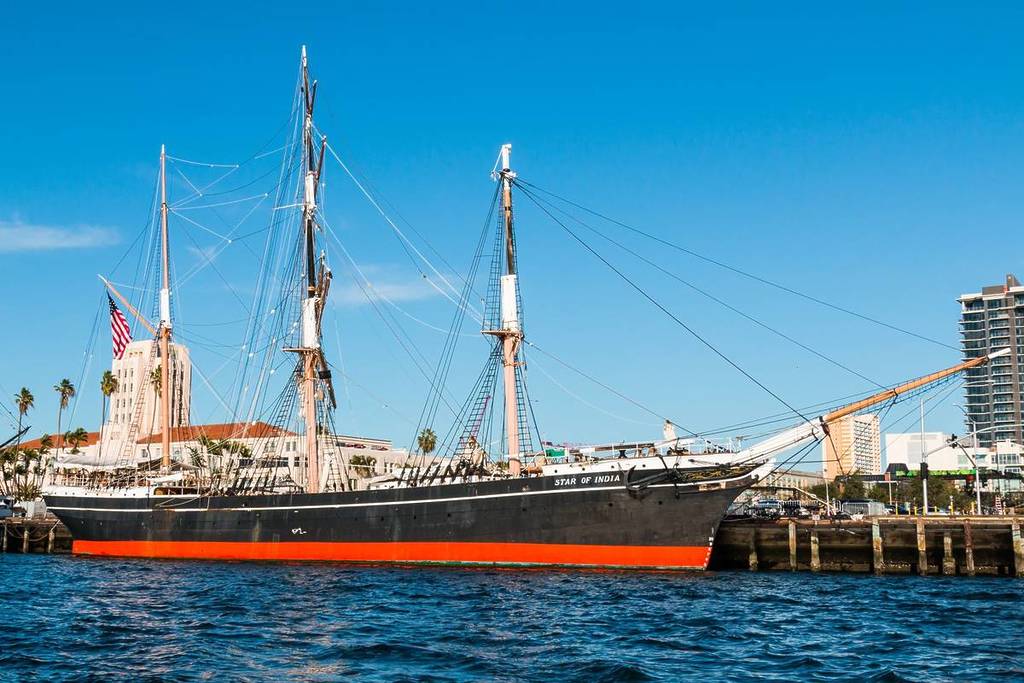

Every San Diegan stared in awe, at least once, at the wonderful Star of India that nowadays calls San Diego home. But as you can imagine, the ship didn’t just show up at the Maritime Museum out of nowhere. Instead, it has a tumultuous, fascinating history. Let’s dig in – or hop aboard – this story.
Star of India – an impressive history
The beautiful boat was built in 1863, at Ramsey Shipyard on the Island of Man. It was somewhat of an experiment, as iron hulls were rare at the time, and wood was the norm. Just 5 months after it was done, the boat was launched and called Euterpe, after the Greek muse of music and poetry.
Her first trips weren’t exactly successful. On her first voyage to India, she endured both a collision and a mutiny. Quickly after, the boat was hit by a cyclone, and the crew had to cut the topmasts to survive. She barely made it to the port. The bad luck continued. Soon after, her first captain died aboard and was buried at sea.
But despite the turbulent beginning, Euterpe settled into a service with less surprises at every turn. The boat completed 4 more runs to India, before being sold to the Shaw Savill Line of London.
London to New Zeeland
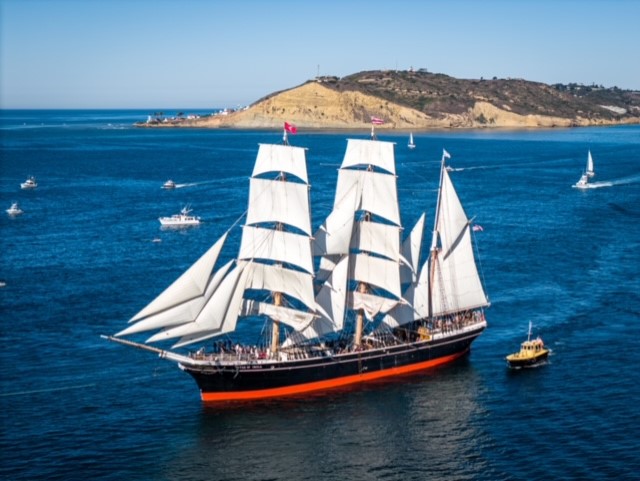
As soon as Euterpe hit London, a new era began, starting a 25-year career transporting emigrants to New Zealand. Along the way, she made stops in Australia, California, and Chile. Over the years, the boat circled the globe 21 times, with some voyages stretching over a year. But don’t think that these journeys were smooth – in fact, most logs we have described tough conditions. One says it was ‘laboring and rolling in a most distressing manner’.
If there’s anyone who had it worse, though, it was the emigrants. They were usually crammed in small spaces, with basic meals such as salted low quality meat, and tough crackers. Seasickness was almost guaranteed for the passengers, who were also battling all sorts of illnesses.
Given the conditions, you’d think many of them didn’t make it to New Zeeland…but that wasn’t the case. Most passengers came from working-class families in England, Ireland, and Scotland. They endured the hardship and built successful lives in New Zealand. The journey was nothing but a true testament to their toughness and determination.
From London to San Diego, its forever home
In 1898, the boat was sold to Americans, and renamed the Star of India in 1906.
Later on, the Zoological Society of San Diego acquired the ship with plans to make her the showpiece of a new museum and aquarium. However, the Great Depression and World War II put restoration efforts on hold.
Finally, in 1976, she returned to the waters of San Diego Bay, which was her first sail in half a century. Today, as we know, the Star of India stands as the crown jewel of the Maritime Museum of San Diego’s historic fleet. This beauty that we get to have is kept seaworthy by a team of passionate volunteers and skilled craftsmen…and she continues to sail at least once a year, making it the world’s oldest active ship.