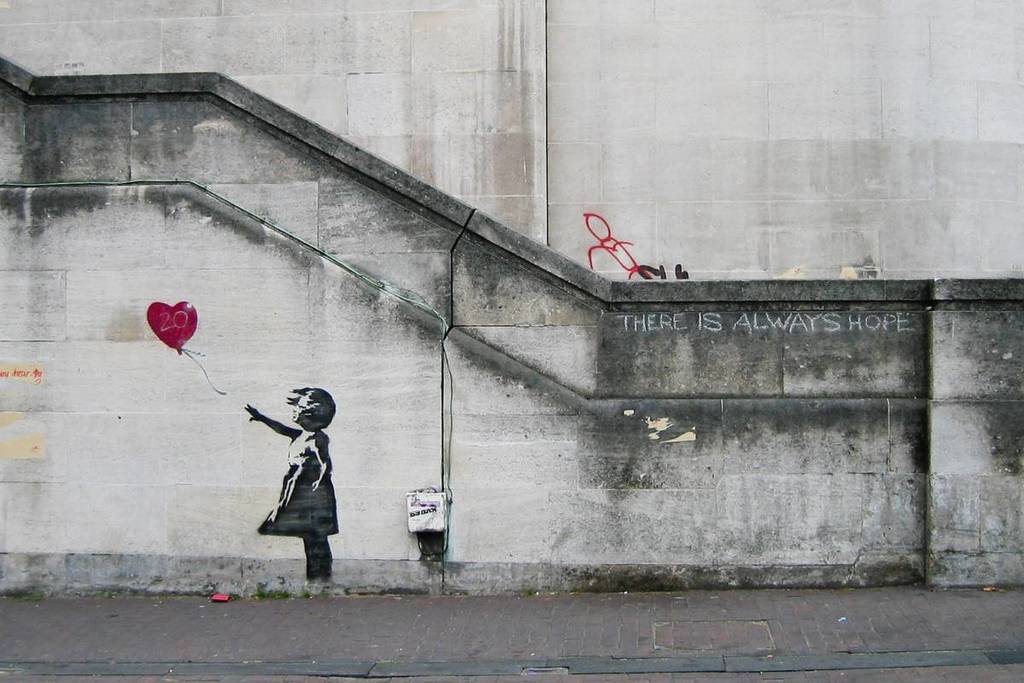

It’s no secret: Banksy is one of the most — if not the most — mysterious artist of all time. Since his work’s appearance in the 1980s, the street artist has been the ultimate enigma. And through that anonymity, he’s given the world iconic pieces like “Girl with Balloon,” “Sweeping it Under the Carpet” and “Kissing Coppers” among countless others.
But over the past few days, people have been like moth to flame in light of a recent investigation by Reuters, claiming to know the identity of the man behind the stencils.
According to Reuters, Banksy is Robin Cunningham, a 1973 Bristol-born graffiti artist who later changed his name to David Jones. And if you’re a true Banksy connoisseur, that name might ring a bell: in 2009, media already pointed the finger at Gunningham — coming close to unearthing Banksy’s true identity. After this close call, the artist allegedly changed his name to David Jones (one of the most common names in the UK), to throw investigators off his scent.
So, what gave Banksy away?
While the search for Banksy kept up — if not heightened — throughout the years, it’s only in recent years that his identity came close to being revealed. Banksy murals started appearing on buildings in Horenka, a village near Kyiv, where witnesses reported seeing two masked men pulling off the intricate stencil work in just minutes. Reuters later linked Cunningham to the area, at the exact same time.
But perhaps even more surprising, the report suggests Banksy wasn’t working alone. Robert Del Naja — speculated in the past to be Banksy himself — supposedly teamed up with Cunningham on many a piece.
Is anonymity crucial in the artist’s case?
Still, this Reuters report is to be taken with a grain of salt. Gunningham’s lawyer, Mark Stephens, reached out to the publication, stating the artist “does not accept that many of the details contained within your enquiry are correct,” and while it may bring us closer to finding out Banksy’s true identity, one must ask: is it even worth it? Stephens himself pointed out the street artist’s anonymity could be a real matter of safety:
“[Working] anonymously or under a pseudonym serves vital societal interests,” Stephens shared. “It protects freedom of expression by allowing creators to speak truth to power without fear of retaliation, censorship or persecution—particularly when addressing sensitive issues such as politics, religion or social justice.”
What do you think? Has the ultimate street art mystery finally been cracked, or is this just another brilliant layer of the Banksy illusion?